Blog

  • Latest in Surface Pattern Design

    Latest in Surface Pattern Design

    This week I’ve been wondering why my “Playful Pattern,” a repeating pattern of Matisse inspired shapes is OVERWHELMINGLY my most popular surface pattern design on Pinterest. Is it because it was pinned a bunch of times on other boards, and therefore acquired some momentum? Or is it really what people like? It has THOUSANDS more views than anything else I’ve posted. One reason I think it works is that I took a palette straight from a Bridget Riley print. Coming up with palettes from scratch can be a little overwhelming, so often I will pick a painting or print from an artist I like, and use the palette:

    To me it’s practically a “throwaway,” one of those designs I start playing around with and doodling with the thought that this wouldn’t really appeal to anyone, it’s just a doodle. I do have fun creating things like that so maybe I should do more? The thing about it is that I don’t really see it on a product that I personally would use. Maybe I should make a tote bag just to see. I’ll bet it would look cute in a nursery. 

    Also popular has been two patterns I created that were inspired by vintage plates. I love thrifting, but I can’t bring everything home. So I created this new process where I photograph old plates (instead of buying them), then I digitize the image into a pattern. It’s very satisfying and I love the idea of recycling older designs. One has a mid century modern feel, and the other is inspired by vintage wallpaper:

    Here are a few couple more I worked on last week. I watched a tutorial from historyrepeating.se, on how to create a trailing floral pattern. It is a great tutorial, and her site is so full of surface pattern design history. Highly recommend it! She demonstrates a process that starts out with stickie notes. Usually I start straight from digital, and when you start using pen and paper, it really loosens things up:

    And lastly, here is one where I combined the trailing floral composition, with the playful pattern, Matisse type style:

  • Create Mockups with AI

    Create Mockups with AI

    As I said in my last post, the idea that you can create all kinds of mockups in AI really blows my mind. Perhaps I’m a little slow to this. When I google the phrase, “create mockups with AI” there are already tons of results, including AI mockup generator apps and video tutorials. After buying a mockup recently on Etsy, (and suspecting it was made with AI!) I decided to try it myself. What I discovered is that it is actually fast and easy, and you don’t need to buy a separate app. 

    Here is what I used:

    ChatGPT to write the prompt.

    Midjourney to generate the image.

    Procreate app to develop the mockup.

    It took less than 30 minutes to create these mockups with AI, to showcase my surface pattern design!

    The one thing that was different from my usual process, was that I decided to try out midjourney. I usually use the Wombo app, which I love: It’s fast, it’s quirky, with lots of really fun filters to play with. I’m constantly creating weird little objects to add to my collages. I had a feeling that Midjourney would create more simple results, with less weirdness. Turns out I was correct. Midjourney was much better than Wombo. Wombo made a little box to put the fabric in – how cute! But not what I was hoping for.

    This is the prompt I used to create mockups with AI:

    “Highly detailed mockup image of a white cloth swatch on a wooden background. The cloth appears soft and premium, with a subtle texture visible in each fiber. Bright, diffused natural lighting emphasizes the smoothness and pristine whiteness of the cloth. The wooden background is warm-toned, with a slight matte finish, creating a tasteful contrast. Shot with a high-resolution DSLR camera, 85mm lens, aperture f/2.8 to capture depth of field with the cloth in sharp focus while the background is softly blurred. The composition feels minimalist and stylish, with a hint of luxury and sophistication.”

    IMidjourney basically churned out what I wanted right away. I then put the same prompt into the Wombo app. The results were somewhat interesting, but I had to do lots of tweaking to get close to what I wanted.

    The implications of this really blows my mind. I can now create endless mockups with all kinds of products. It inspires me to jump back into the print on demand business. It also inspires me to get back to creating digital products, and to use the AI mockups to help the buyer envision the product as art that they can hang on their walls. And it’s much easier than these mockups I painstakingly created in my living room:

  • Using AI for Fashion Design

    Using AI for Fashion Design

    Have you considered using AI for fashion design? There are many different ways to approach it, and likely multiple AI apps that specifically cater to this. For my purposes, I wanted to create some simple AI images of models wearing dresses, and use them to visualize how my surface pattern designs would look as fabric. When I started really diving into this process, it became very fun and inspiring. It reminded me of playing with fashion plates as a child. 

    My current process does not involve directly using AI for fashion design. Rather, it is a roundabout way to use AI images and dress them up with patterns I have created. First I started creating simple images of models wearing a white dress. I then used the procreate app to overlay my pattern designs. I find this so satisfying! It’s like being a virtual art director in a world you create. 

    But I quickly got bored and wanted to see how far I could take it. I started grabbing pictures of models from websites, and collaging them with flowers and other digital details. It quickly got very whimsical!  I found that there is a technique that when you use a starter image that looks like a magazine page, the AI will take that as a cue without you having to put it in the prompt. Which is very helpful because the wombo app seems to take things very literally. It helps to bring in subtle ways to influence it with your seed image, rather than depending on the prompt. 

    Using AI for fashion Design Mock-ups

    I recently bought a fabric swatch mock-up on Etsy. It was so easy to use, and the bonus was that it worked with the Procreate app. Many, many mockups are only designed for Photoshop, which I don’t typically use. As I plugged in my pattern to the Procreate file, on closer inspection, I realized that the mockup I bought was most likely created with AI! It was only $5, and it actually looks decent.

    And now I can see an efficient workflow to create my own mockups in procreate, which has always been a quest of mine. There are so many available for purchase, but, you know, I like to do things the hard way, creating mockups by photographing things around the house. Which has been a fun exercise, but the thought of creating any mockup I can think of with AI  – well it kind of blows my mind. 

  • The Complete New Yorker DVD Set

    The Complete New Yorker DVD Set

    I grew up in the 70’s and 80’s and a consistent thing in my childhood, was that there was always a New Yorker magazine lying around. As a kid I would pick them up and read them out of boredom. I was initially interested in the cartoons, and sometimes the ads, which were minimal. I eventually matured enough to read movie reviews (Pauline Kael!) and short fiction (Anne Beattie! Frederick Barthelme!) Oh, to be that bored again; with no internet, no iPhone, and not that many TV channels. There was something about a rainy day – you would pick up some books or magazines that are lying around, and all of a suddenly your boredom was replaced by sparks of the imagination.

    (Later, in 1998 I wrote in my journal, “boredom is the silent killer of joy.” Not altogether sure of what I meant by this, but I do think it is significant that I wrote it in 1998, at the start of the digital age of endless content. But how can I look back on boredom as both a way to spark the imagination AND a silent killer of joy? Maybe it can be both.)

    In 2005 my dad purchased The Complete New Yorker DVD set. It retailed for $100 and contained 8 disks, which contained the totality of all of the New Yorker magazines from 1925 – 2005. It also came with a nice book that had some of the cover images. My dad loved those DVDs but unfortunately he lost them. One day in 2023, I came across the set in a thrift store, retailing for $15. I was shocked that it was so cheap. But I immediately looked it up on eBay and saw the same item listed for $12 (Now I am looking it up and see that you can obtain it for $7!) So I bought it and soon began to realize why it was so cheap. 

    My plan was to give the Complete New Yorker DVD set to my dad, but unfortunately we couldn’t find a computer that they would work on. Even using a laptop with an external DVD drive – we kept getting an error message. Perhaps this is why the DVDs are so cheap on eBay. I did however, have one computer up my sleeve to try – my ancient iMac, also purchased in 2005. I’ve held on to it, despite its supposed obsolescence. I loaded the New Yorker DVDs in and … they worked!

    So now I have the ancient iMac in a cozy corner of my house, and its only use is to peruse old New Yorker issues. I enjoy reading them in that form – scanned PDFs. Of course you could sign up for a pricy subscription and have access to the archives that way. But there is something about using this old software, on an old computer and reading the old issues that way. Of course the real delight would be to find actual vintage New Yorker magazines at a thrift store or estate sale, but they are very hard to come by. 

    For now, I crawl into the archives from time to time and screen shot some of the cartoons, covers, and ads. The articles are fantastic – so well written and a fascinating way to relive the history of the 1970-2005. Back then the New Yorker was a bit more nuanced and reserved as far as political content goes, which makes for more interesting reading. Especially on a rainy day. 

  • The Strange Beauty of Flawed AI Art

    The Strange Beauty of Flawed AI Art

    AI art, with all its glitches and idiosyncrasies, presents a fascinating paradox. These digital creations, often riddled with imperfections, have a unique charm that captivates in unexpected ways. Sure, AI stumbles—frequently, in fact. Just look at the fingers. But these glitches hold a peculiar allure.

    Future Generations and AI Art

    Projecting into the future, one can’t help but wonder: will the flawed AI art of today interest future generations? I think it will. As technology continues its relentless march forward, the glitches of contemporary AI artworks might be viewed with a sense of nostalgia, someday forming their own retro aesthetic. Tomorrow’s digital natives could very well see our era’s AI art as a quaint artifact, a testament to the early days of machine creativity.

    AI vs. The Artist

    Can AI aspire to the artistic heights of an artistic genius like Michelangelo? For now the answer is no, but anything could change. The Sistine Chapel, with its profound humanism and divine inspiration, was not conjured by an algorithm. And yet, this is no slight against AI. The value of AI art lies not in replicating the masterpieces of the Renaissance but in carving out its own niche. It offers a new kind of beauty—unpredictable, experimental, and distinctly modern.

    The AI Art Market

    The accessibility of AI art tools means the market is, predictably, saturated. But does this abundance preclude value? Not necessarily. Art thrives on stories, on uniqueness. Even in a deluge of digital art, there is space for pieces that tell a compelling story or possess a unique genesis. The market can sustain itself through limited editions, authenticated by blockchain technology, ensuring rarity and value in an otherwise flooded space.

    Flawed AI Art can by Beautiful or Horrifying

    Flawed AI art is an intriguing blend of technology and creativity. Its imperfections are not detriments but rather integral to its charm. While it may never replace the timeless masterpieces of human artists, AI art adds a fresh, dynamic dimension to the art world. The future of AI art, with all its glitches and eccentricities, promises to be both captivating and thought-provoking. Whether that is something to look forward too, or something to be horrified by, remains to be seen. 

  • Stringing Beads for Meditation

    Stringing Beads for Meditation

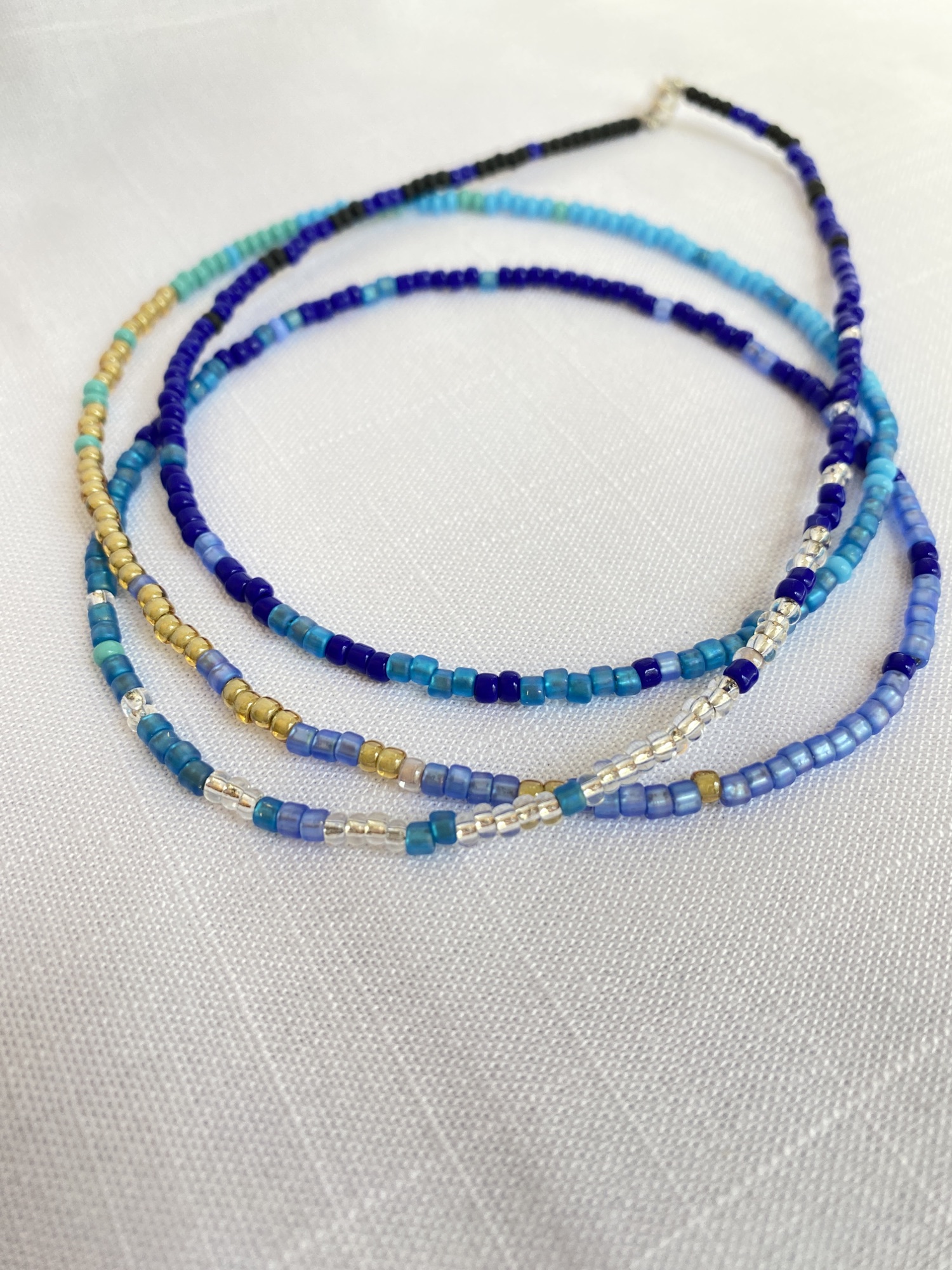
    I recently got back into jewelry making as a break from digital art. Every once in awhile I get overcome with the addictiveness of easily generating images. It feels like I’m making too many things, too quickly. In these situations I look for a way to slow it down. Sometimes I go back to painting but other times I like to string beads. For most of my adult life I have always had a box or a tin full of seed beads and stuff to string them on. Recently I got back into it and I started to contemplate the meditative nature of it. 

    Stringing beads is an ancient practice.

    Stringing beads as a form of meditation has always existed in the culture. It’s an ancient practice that transcends time, and spiritual beliefs. The repetitive act of selecting, threading, and arranging beads can produce a state where the mind can quiet itself and focus. Historically, the practice of stringing beads dates back thousands of years, and in many cultures beads are used in prayer. In ancient Egypt, beads were used in burial rites, symbolizing protection and guidance in the afterlife. In many cultures, beads are used in prayer. The mala beads of Hindu and Buddhist traditions, the rosary in Christianity are both examples of moving one bead to the next to focus on a prayer or meditations. 

    Marina Abramović on repetative tasks for meditation

    Marina Abramović touches on this phenomenon in her work “Counting the Rice.” The piece involves participants sitting for extended periods, counting and separating grains of rice. Abramović states, “Technology is great but it’s also a dangerous thing. We have to learn how we can gain free time back for ourselves. The only way to emerge is with some long durational activities, such as Counting the Rice.”

    “You might think it’s crazy to sit and count rice, but this is exactly what you have to do to reclaim time. If you can’t count the rice for three hours, you can’t do anything good in life.”

    Abramović’s “Counting the Rice” and the practice of stringing beads both illustrate the power of simple, repetitive actions to transform the mind. They remind us that meditation can be found in everyday mundane tasks, when we approach them with intention and focus.

    Stringing beads is more than a crafty pastime. It’s a meditative practice rooted in ancient traditions. The tactile nature of the beads, combined with the rhythmic motion of stringing them, brings about a state of mindfulness. Eventually I got tired of this (and too busy with my other responsibilities in life.) But I love that there is a big box of beads just waiting for the next time I open it.